preload-image

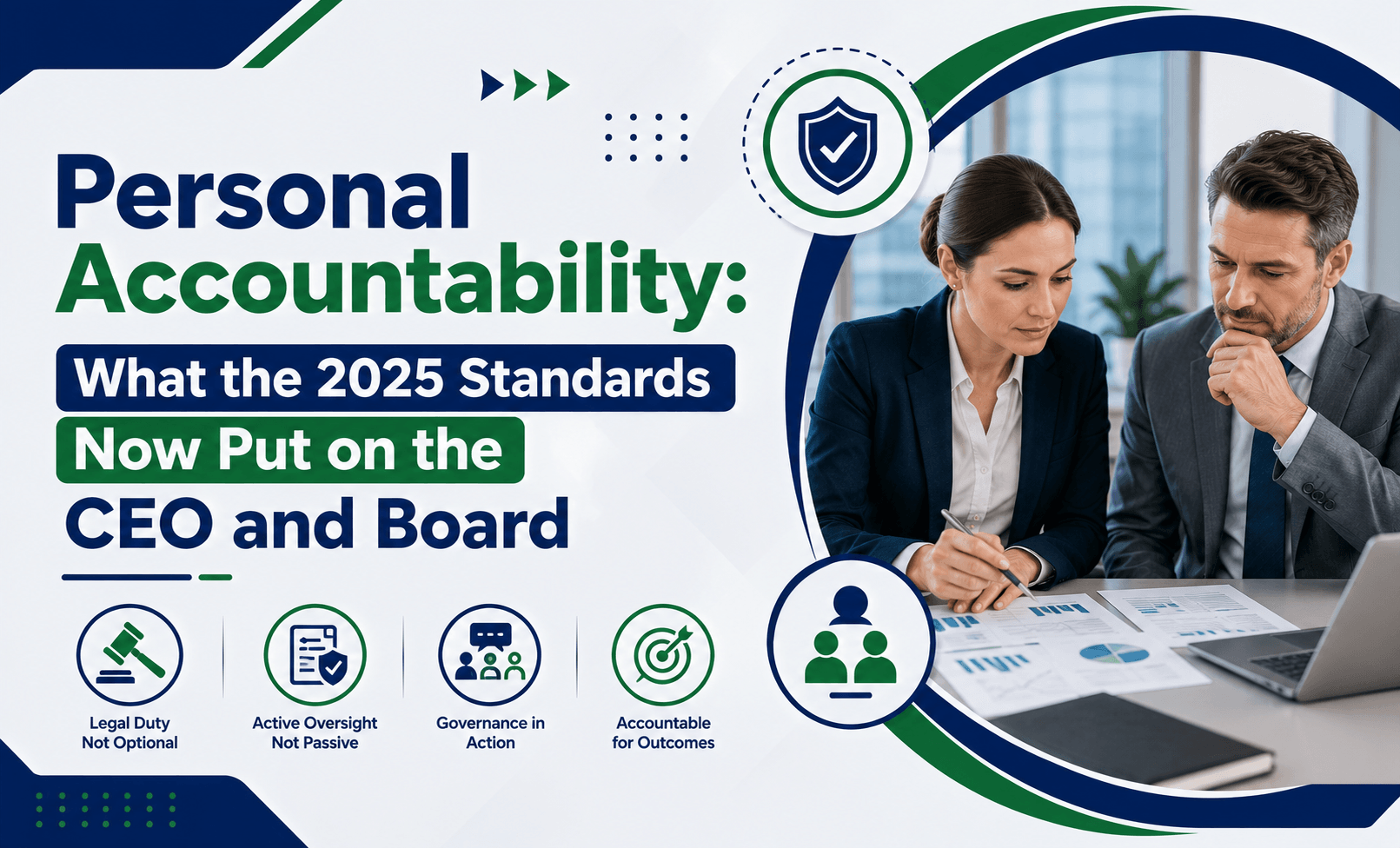
Personal Accountability: What the 2025 Standards Now Put on the CEO and Board

Quality Area 4 · Governance

◆ Who owns this: CEO / Board / Governing Persons

The short version: the 2025 Standards put accountability for integrity and a culture of compliance squarely on an RTO’s governing persons. It is no longer enough for compliance to live with a compliance manager. The CEO and board must be able to evidence active, ongoing oversight — that they identify risks, make informed decisions, and lead a culture of integrity, fairness and transparency.

If there is a single headline change in the 2025 Standards, it is this one. Quality Area 4 reframes governance from a back-office function into a leadership responsibility with the names of actual people attached to it. For a CEO, that is the difference between “my compliance team handles that” and “I can show the regulator how I oversee it.”

What the Standard actually says

In plain terms, Quality Area 4 expects an RTO to operate with integrity and maintain accountability for the delivery of quality services. It expects governing persons to be fit and proper, to be suitable to oversee the organisation, to act diligently and make informed decisions that facilitate compliance, and to lead a culture of integrity, fairness and transparency.

Read that last phrase again, because it is doing a lot of work. “Lead a culture” is not a document you can produce. It is a pattern of behaviour you have to evidence over time.

Why this is harder than it looks

Most RTOs can produce a governance policy. Very few can produce evidence that governance is operating. That gap is exactly where the exposure sits. A policy says what should happen. ASQA’s self-assurance lens asks what did happen, how often, and what changed as a result.

Two failure patterns are especially common:

  • The annual-review trap. Governance that consists of one board review a year cannot evidence active oversight. Compliance risk moves faster than that.
  • The shadow-director problem. If a person exercises real influence over the RTO but is not recognised as a governing person, your fit-and-proper assurance has a hole in it. ASQA is alert to influence that does not appear on the org chart.

The question that exposes most boards. “Show me how the board identified, discussed and acted on a compliance risk in the last quarter.” If the honest answer is “we reviewed the compliance report and noted it,” that is not oversight — that is reception. Oversight is visible decisions and visible follow-through.

What good evidence looks like vs what fails

✓ Holds up

Scheduled governance meetings with minuted compliance decisions and owners
A live risk register the board actually engages with
Evidence of risks identified, actioned and closed — with dates
Declarations and monitoring that keep governing persons fit and proper
Clear recognition of everyone who exercises influence over the RTO

× Gets flagged

One annual governance review and nothing in between
A risk register that exists but is never updated or discussed
Compliance reports received but no decisions or follow-through
No process to keep fit-and-proper status current
An influential individual who is not recognised as a governing person

What a CEO should do this quarter

  1. Put governance on a cadence. Monthly or quarterly, not annual. Minute the compliance decisions, assign owners, and track them to completion.
  2. Make the risk register a living document. The board should touch it every meeting — new risks in, closed risks out, ratings reviewed.
  3. Map who really has influence. Make sure every person with genuine sway over the RTO is recognised and assessed against the Fit and Proper Person Requirements.
  4. Create a paper trail of culture. Decisions that favour integrity over convenience — especially the hard ones — are your best evidence of leading a culture of compliance.
  5. Connect governance to self-assurance. The monitoring-and-improvement loop in 4.3/4.4 is how the board sees whether the organisation is actually working.

Can your board evidence active oversight?

The free Risk Scorecard scores your Governance exposure — and shows whether your oversight would hold up to ASQA’s self-assurance lens.

Frequently asked questions

Quality Area 4 places accountability for integrity and a culture of compliance on the RTO’s governing persons. Governing persons are expected to be fit and proper, act diligently, make informed decisions that facilitate compliance, and lead a culture of integrity. This is a clear shift toward personal accountability at the leadership level.

A governing person is someone who participates in governing the organisation — typically directors and those with genuine influence over its direction and decisions. Importantly, influence that is not reflected on the formal org chart (sometimes called shadow directorship) can still bring a person within scope.

Culture cannot be shown with a single policy. Evidence comes from a pattern over time: minuted governance decisions, a live risk register, risks actioned and closed, and decisions that prioritise integrity. The monitoring and continuous improvement loop in Quality Area 4 is central to demonstrating it.

There is no mandated frequency, but an annual review alone rarely evidences the active, ongoing oversight the 2025 Standards expect. A monthly or quarterly governance cadence with documented decisions is far more defensible.

Leave a comment

Related posts

Product was successfully added to your cart!
Enquire Now
×

    Enquire Now