preload-image

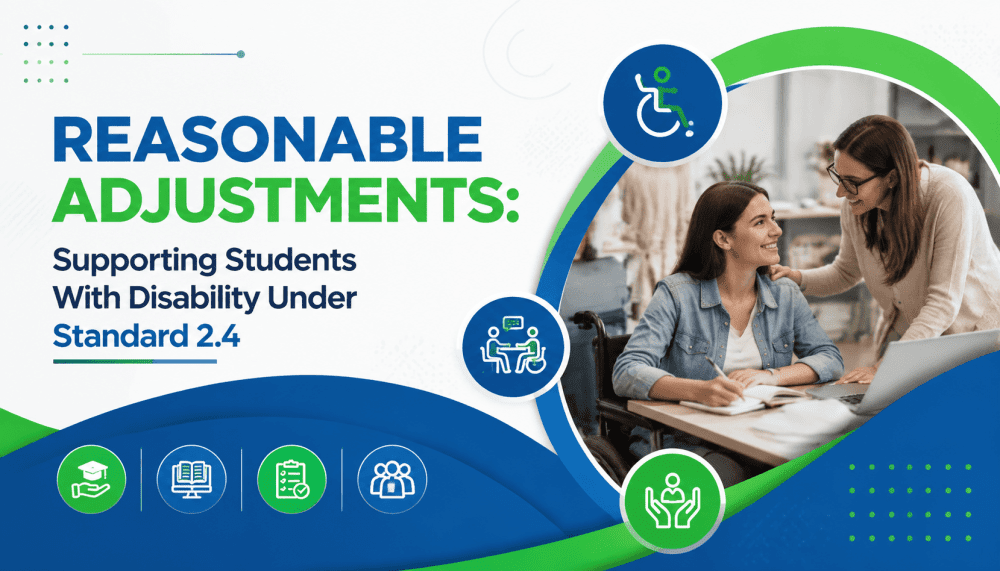
Reasonable Adjustments: Supporting Students With Disability Under Standard 2.4

Quality Area 2 · VET Student Support

◆ Who owns this: Student Services, Trainers & the Compliance Manager

The short version: Standard 2.4 requires RTOs to make reasonable adjustments so students with disability can access and participate in training and assessment on an equal basis. The adjustment must support equal participation without compromising the integrity of the competency being assessed — and RTOs get exposed when adjustments are inconsistent, undocumented, or refused outright.

Reasonable adjustment is both a compliance obligation and a disability-rights one. Standard 2.4 makes it explicit: students with disability must be able to participate on an equal basis. The skill is making genuine adjustments that preserve the integrity of what is being assessed.

What Standard 2.4 requires

Reasonable adjustments must be made to support VET students with disability to access and participate in training and assessment on an equal basis. A reasonable adjustment is a measure that allows a student to participate without changing the essential requirements of the competency — for example, adjusting the format, timing, or environment of assessment, or providing assistive technology.

Where RTOs get exposed

  • Adjustments refused or discouragedTreating an adjustment request as a problem rather than an obligation.
  • Inconsistency.  Adjustments that depend on which trainer a student happens to get.
  • Compromising the competency. The opposite failure — adjusting so far that the student is no longer assessed against the actual requirements.
  • No documentation.  Adjustments made informally with no record of what was provided or why.
  • No link to pre-enrolment.  Needs not identified early, so adjustments are scrambled together late.
The line to hold. A reasonable adjustment changes how a student demonstrates competency, never whether they have to. Adjust the access, not the standard. Get that distinction right and you satisfy both the disability obligation and assessment integrity..

What good practice looks like vs what fails

✓ Holds up

A clear, consistent reasonable-adjustment process
Adjustments that preserve the integrity of the competency
Needs identified early, ideally at pre-enrolment
Documented adjustments — what was provided and why
Staff who understand their adjustment obligations

× Gets flagged

Adjustment requests refused or discouraged
Adjustments varying by trainer
Adjustments that compromise the competency
No record of adjustments made
Needs discovered too late to support properly

How to close the gap

  1. Standardise the process. A consistent path for requesting, assessing and providing reasonable adjustments.
  2. Protect competency integrity Adjust access and method, never the essential requirements.
  3. Identify needs early. Use pre-enrolment to surface adjustment needs before training starts.
  4. Document everything.Record the adjustment, the rationale, and the outcome.

Are your adjustments consistent and documented?

TThe free Risk Scorecard scores VET Student Support exposure — including reasonable adjustments and equal participation.

Frequently asked questions

It requires RTOs to make reasonable adjustments so students with disability can access and participate in training and assessment on an equal basis. The adjustment should enable equal participation without changing the essential requirements of the competency.
No. A reasonable adjustment changes how a student demonstrates competency — for example the format, timing, environment, or use of assistive technology — not whether they must meet the essential requirements. Adjusting so far that the competency itself is compromised is a failure
Adjustments must be reasonable and must preserve the integrity of the competency. The obligation is to genuinely support equal participation; where a specific request would compromise the essential requirements, the RTO works to find an alternative adjustment that does not.
Record what adjustment was provided, the rationale, and the outcome. Identifying needs at pre-enrolment and documenting the response evidences both the support provided and that competency integrity was maintained.
Sources: Outcome Standards Instrument 2025 (F2025L00354), Quality Area 2 (Standard 2.4); Disability Standards for Education 2005; ASQA Practice Guides. Verified June 2026.

Leave a comment

Related posts

Product was successfully added to your cart!
Enquire Now
×

    Enquire Now