preload-image

Common ASQA Non-Compliance Findings and How to Avoid Them

For RTO managers and compliance officers, the clearest public pattern in recent ASQA Non-Compliance Findings is not obscure paperwork; it is recurring weakness in training design, assessment quality, and trainer/assessor capability.
In ASQA’s 2023–24 and 2024–25 Annual Reports, the most commonly assessed standards and the most common areas of non-compliance centred on training and assessment strategies and practices, effective assessment, and skilled trainers/assessors.
In parallel, ASQA’s current regulatory risk priorities emphasise shortened course duration, inadequate or fraudulent RPL, misleading marketing, non-genuine providers, and the integrity of student work placementsstudent work placement integrity.

That matters because ASQA’s current audit approach is broader than a document check. In a performance assessment, ASQA asks whether your practice aligns with the Standards, whether you have systems for ongoing compliance, and whether you monitor, review and continuously improve your operations.

In other words, an RTO can fail not only because a form is missing, but because its systems do not reliably produce compliant training outcomes.
In this blog, we will discuss the common ASQA non-compliance findings and how to avoid them.

ASQA and the current scope of non-compliance

ASQA is Australia’s national regulator for vocational education and training, and the current 2025 Standards for RTOs took effect on 1 July 2025. Those standards are supported by separate legislative instruments for the Outcome Standards and the Compliance Standards/Fit and Proper Person Requirements.
ASQA’s most recent public annual-report statistics on “common non-compliance” still summarise findings under the 2015 Standards for RTOs, because much of that reporting period involved assessments and enforcement activity recorded under that framework.
At the same time, ASQA’s live guidance for providers is now organised under the 2025 Standards. For that reason, this article uses both sets of references: the 2015 clauses to show where non-compliance has been most common in public reporting, and the 2025 practice guides and instruments to explain how to avoid the same issues now.

A clause-by-clause public concordance is not fully specified as a one-to-one ASQA crosswalk, so any topic-level mapping below is indicative rather than a formal published concordance.
ASQA’s public description of performance assessment shows why “scope of non-compliance” is wider than many providers assume.
ASQA typically moves through initial contact, opening meeting, evidence collection, closing meeting and then findings/reporting.
The evidence it may request includes policies, procedures, strategies, student files, completed assessments, trainer/assessor records, site observations and interviews with management, trainers/assessors and students over 18.

The most common ASQA non-compliance findings

The priority order below is based first on what ASQA has publicly reported most often in recent annual reports, and then adjusted for seriousness using ASQA’s current risk priorities, strategic reviews and recent integrity enforcement actions. Examples are anonymised composites built from those official patterns; they are illustrative, not verbatim case digests.

Training design does not match the training product, learner cohort, or amount of training

What ASQA commonly sees

In both 2023–24 and 2024–25, ASQA reported that the most common non-compliance themes included implementing, monitoring and evaluating training and assessment strategies/practices.
Under the 2025 Standards, ASQA’s Training Practice Guide says training must be consistent with the training product, use appropriate delivery modes, provide sufficient time for instruction, practice and feedback, and give students access to support and resources.
ASQA also explicitly identifies risks such as failing to consider the volume of learning, shortening delivery without sufficient time for skill development, and relying on online delivery where practical skills require physical environments.

Typical causes

The recurring root causes are generic “one-size-fits-all” strategies, copied commercial resources not reviewed for full unit coverage, enrolment-driven short durations, thin industry consultation, and a weak understanding of the starting capability of the learner cohort, including LLND needs and prior experience.
ASQA’s amount-of-training guidance says the amount of training must be sufficient for the learner cohort, training product and delivery mode, and should be documented and measurable.

How to avoid it

Build and routinely update a product-level delivery strategy, whether or not you still call it a TAS.
It should clearly document learner cohort characteristics, entry assumptions, delivery mode rationale, pacing, contact hours, supervised practice, work placement timing where relevant, support arrangements, and industry consultation that has influenced electives, sequencing and delivery settings.
ASQA’s FAQs note that the 2025 Standards do not prescribe a TAS template, but providers are still expected to show how their strategies for training and assessment are compiled and presented.

Checklist item

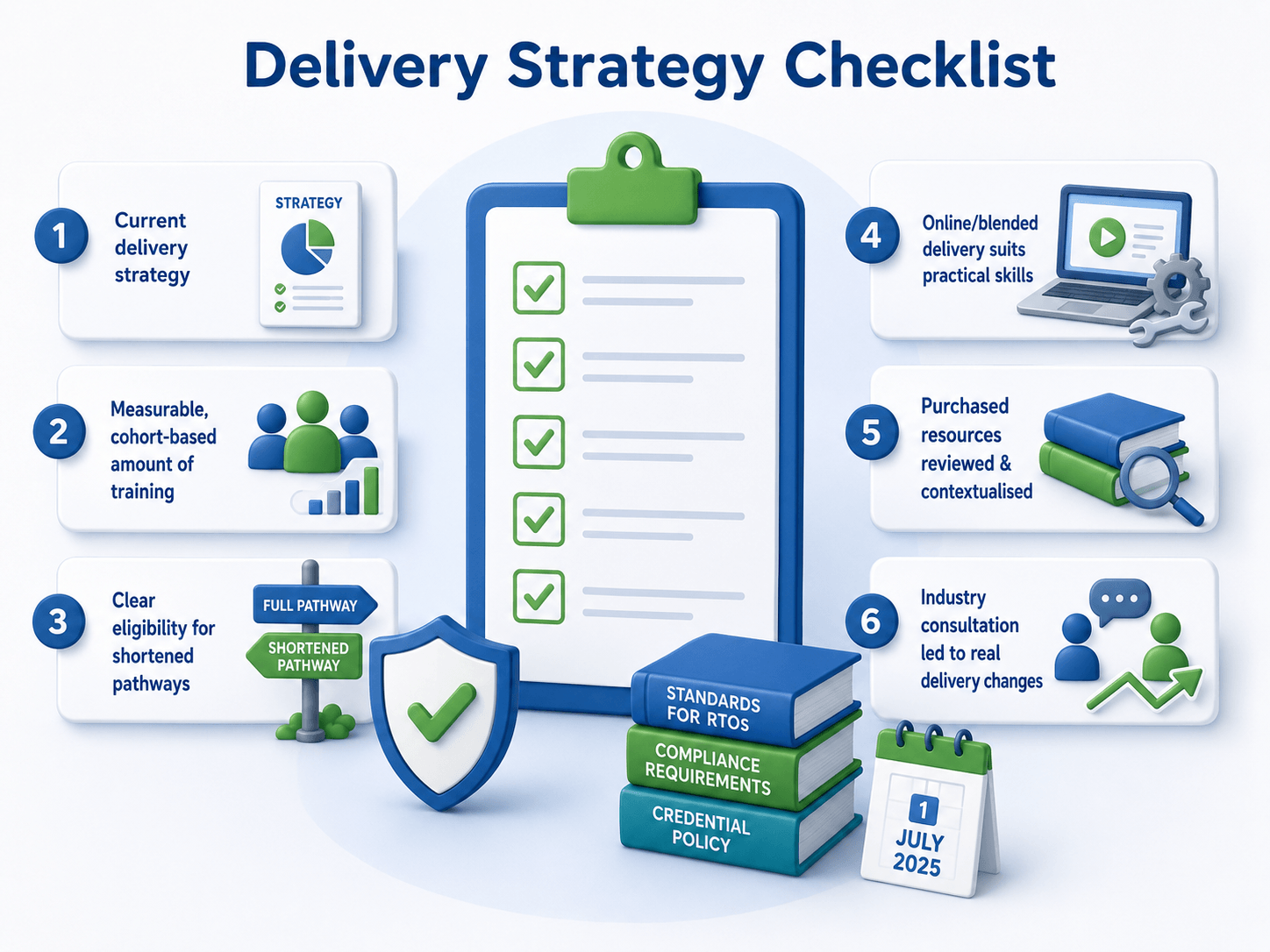
Confirm that each product has a current delivery strategy; the documented amount of training is measurable and cohort-based; shortened pathways have clear eligibility criteria; online or blended delivery is defensible for the practical skills required; purchased learning resources have been reviewed and contextualised; and industry consultation has changed something concrete in delivery, not just signed off on a template.

Suggested evidence for audit

Provide the strategy or equivalent planning document, cohort analysis, training schedules, timetables, LMS engagement design, attendance/contact records, LLND and support pathways, industry consultation minutes, validation or post-cohort review notes, resource-mapping records, and version history showing continuous improvement.

Assessment tools and assessor judgment are not robust enough

What ASQA commonly sees

“Conducting effective assessment” was one of ASQA’s most common non-compliance themes in both recent annual reports. Under the 2025 Assessment Practice Guide, ASQA expects assessment to be consistent with the training product, reviewed before use, and conducted in line with the principles of assessment and rules of evidence.
The guide specifically flags reliance on purchased tools that are not contextualised, generic review checklists, and poor handling of authenticity, validity and sufficiency.

Typical causes

Common causes include treating mapping as a formality, over-relying on written questions for skills that require performance evidence, weak instructions to students and assessors, inadequate practical observation, limited moderation or validation before use, and poor controls over authenticity in online assessment.
ASQA’s guide to assessment tools also stresses that tools must be practical, aligned to the Standards and capable of producing defensible evidence.

How to avoid it

Rebuild assessment from the training product outward: map every unit requirement, identify what real performance must be seen, define conditions of assessment, specify what counts as sufficient evidence, and test authenticity controls for online or third-party environments.
Review tools before use with industry input, moderation, and trialling with a comparable cohort. Validation should then test both the tools and the consistency of judgment across assessors.

Checklist item

Check that each tool is mapped to the current training product; practical evidence is collected where practical competence is required; reasonable adjustments do not remove mandatory evidence; authenticity controls are documented; assessors record reasons for judgement; new or amended tools are reviewed before deployment; and post-delivery validation leads to changes, not just minutes.

Suggested evidence for audit

Provide assessment mapping matrices, marked assessments, observation tools, assessor guides, benchmark answers, validation schedules and reports, moderation records, student resubmission/reassessment records, assessor judgement notes, online proctoring or authenticity controls where relevant, and change logs showing enhancements after review.

Trainers and assessors are not properly credentialled, supervised, or current

What ASQA commonly sees

ASQA’s annual reports repeatedly identify non-compliance in employing skilled trainers and assessors. Under the 2025 Standards, training and assessment must be delivered by appropriately credentialled people, and where someone works under direction, they must not make assessment judgements. ASQA’s workforce guidance also stresses authentication of credentials, current training and assessment capability, relevant vocational competence, and current industry skills.

Typical causes

The usual weaknesses are incomplete trainer matrices, assumptions that holding a TAE alone proves vocational competence for all units delivered, poor evidence of industry currency, failure to record supervision of people working under direction, and lack of clarity when industry experts contribute to assessment. ASQA explicitly identifies risks such as allowing under-directed staff to make assessment judgements and failing to document how industry experts were involved.

How to avoid it

Maintain a live trainer/assessor matrix that links every person to every unit delivered, showing credential status, vocational competence, industry-currency evidence, CPD, and supervision arrangements where applicable. Authenticate qualifications, gather objective industry-currency evidence, document gaps and remediation, and make supervisory direction visible in assessment materials where someone is working under direction.

Checklist item

Confirm every person delivering or assessing is credentialled under the Credential Policy; under-direction staff do not make assessment judgements; unit allocation is supported by evidence of vocational competence; industry currency is recent and role-relevant; industry experts work under documented direction; and supervisors have time and capability to supervise properly.

Suggested evidence for audit

Provide trainer matrices, authenticated qualifications, transcripts, certified copies, vocational-mapping analyses, PD and industry-engagement logs, position descriptions, induction records, supervision plans, observation/monitoring notes, and assessment records showing who actually made the judgement.

Recognition of prior learning is treated as a shortcut instead of a rigorous assessment pathway

What ASQA commonly sees

RPL is now a formal ASQA risk priority and a major integrity issue. ASQA says it has ongoing concerns about inadequate or fraudulent RPL practices; its risk material points to aggressive marketing, third-party brokers, low-quality high-volume assessment models, and under-reporting of RPL activity. In the 2025 RPL and Credit Transfer Practice Guide, ASQA warns against business models that “cut corners”, easy/quick RPL marketing, failure to verify authenticity, weak currency checks, and outsourcing to third parties that do not apply the Standards properly.

Typical causes

The main causes are commercial pressure, migration/funding incentives, broker-driven student acquisition, poor assessor oversight, lack of gap training, weak evidence testing, and confusion between credit transfer and RPL. ASQA’s student-facing RPL guidance also makes clear that evidence should be matched to course requirements by a qualified assessor and that extra training may be needed where evidence does not fully meet requirements.

How to avoid it

Treat RPL as assessment, not admissions. Use structured evidence kits, competency conversations, challenge tasks, workplace verification, current-document checks, and clearly documented judgement against each unit requirement. Where evidence is incomplete, prescribe gap training and reassessment rather than issuing partial or full credit by assumption. Tighten controls over any third-party involvement and eliminate “guaranteed RPL” language from all marketing.

Checklist item

Check that RPL decisions are documented unit by unit; evidence authenticity and currency are actively tested; assessors are qualified and vocationally relevant; brokers do not control the assessment process; students receive clear information about RPL and gap training; and credit transfer is granted only on authenticated equivalent completion evidence, not on broad assumptions.

Suggested evidence for audit

Provide RPL policy and workflow, assessor guides, mapping and judgement records, interview notes, third-party due diligence files, employer verification records, gap-training plans, credit-transfer authentication records, and management reviews of RPL outcomes and trends.

Governance, third-party oversight, and marketing controls are too weak

What ASQA commonly sees

Even where the original trigger is training or assessment, recent decisions show that ASQA and the Tribunal look at governance as a root cause.
Under the 2025 Standards, ASQA’s Accountability, Information and Transparency, Risk Management, Feedback/Complaints, and Annual Declaration guidance all reinforce that the RTO remains fully responsible for third parties, marketing accuracy, legal compliance, and self-assurance.

Typical causes

Recurring causes include CEOs signing the Annual Declaration on Compliance without testing evidence, weak due diligence before appointing third parties, failure to notify ASQA of new or ceased third-party arrangements, unclear student communications about who delivers what, inaccurate or outdated advertising, misleading claims about duration or licensed outcomes, and poor complaint escalation from agents or third parties.

How to avoid it

Move from passive compliance to operational governance. Use a formal third-party register, due diligence checklist, approval workflow, monitoring schedule, marketing approval matrix, complaints escalation protocol, and executive dashboard that reviews leading indicators such as duration, completion, support requests, reassessment rates, trainer coverage, student complaints and regulator notifications. ASQA’s risk-management guidance explicitly warns against “technical compliance” that does not actively manage risk to intended outcomes.

Checklist item

Check that all third-party agreements are written, current and notified to ASQA where required; students are told what the third party does; marketing includes the correct code/title and does not imply guaranteed completion, licence or employment; complaint and appeal processes are easy to access and include independent review pathways; material changes are notified within time; and ADC responses are supported by retained evidence.

Suggested evidence for audit

Provide the third-party register, signed agreements, due diligence records, monitoring reports, marketing approvals and screenshots, complaints/appeals logs, corrective-action reports, executive and governance minutes, ADC working papers, material-change notices, insurance evidence, and risk register/business continuity records.

One-page printable checklist

Training and delivery

  • Every active product has a current strategy or equivalent planning document linked to the learner cohort.
  • The amount of training is measurable, defensible and reflects cohort needs, product complexity and mode of delivery.
  • Online or blended delivery has been justified for the practical skills required.
  • Industry engagement records show actual impact on delivery, sequencing or electives.

Assessment

  • Assessment tools are mapped to the current training product and include practical evidence where required.
  • Authenticity controls are documented for online, workplace or third-party evidence.
  • Validation and moderation records show changes made, not just meetings held.

Workforce

  • Trainer/assessor files contain authenticated credentials, vocational-competence evidence and recent industry currency.
  • People working under direction are not making assessment judgements, and supervision is recorded.

RPL and credit transfer

  • RPL is assessed with the same rigour as normal assessment, including authenticity and currency checks.
  • Credit transfer decisions are based on authenticated equivalence, not assumptions.
  • Gap training is documented where evidence does not fully demonstrate competence.

Governance and compliance

  • All third-party arrangements are current, written, monitored and notified where required.
  • Marketing includes the correct product code/title, avoiding guarantees, and clearly identifying third-party services.
  • Complaints and appeals processes are accessible, timely and capable of independent review.
  • ADC responses and executive assurances are backed by retained evidence.
  • Management reviews risks, trends and corrective actions at least monthly.

Final Verdict

ASQA non-compliance findings rarely come from one isolated document error. They usually show a deeper weakness in how the RTO designs training, conducts assessment, manages trainer and assessor capability, verifies RPL, monitors third parties, and reviews its own compliance systems.
The practical lesson is clear. RTOs need to move away from “audit preparation” as a last-minute activity and build compliance into everyday operations. A compliant RTO should be able to show not only that documents exist, but that those documents are current, implemented, reviewed, and improving actual training and assessment outcomes.
The strongest protection is evidence. If your RTO can prove that training is cohort-based, assessment is valid and sufficient, trainers are competent and current, RPL is genuinely assessed, and governance decisions are backed by monitoring records, then your compliance position becomes much stronger.

The best approach is to review risk areas regularly, act on gaps early, and keep clear records of improvement. ASQA’s focus is no longer only on whether an RTO has policies in place. The real question is whether the RTO can demonstrate that its systems are working in practice.

FAQs

ASQA non-compliance findings are issues identified when an RTO does not meet the required standards, legislative obligations, or expected training and assessment practices. These findings may relate to training delivery, assessment quality, trainer and assessor capability, RPL, marketing, governance, or student support.
The most common findings usually involve weak training and assessment strategies, poor assessment evidence, incomplete trainer and assessor records, inadequate RPL processes, misleading marketing, and weak governance over third-party arrangements.
RTOs often become non-compliant because their documented systems do not match actual practice. Common causes include outdated resources, poor validation, insufficient monitoring, weak internal review processes, and failure to keep evidence that proves compliance.
An RTO can reduce risk by maintaining current delivery strategies, mapping assessment tools carefully, validating assessment outcomes, keeping trainer files updated, checking RPL evidence properly, monitoring third parties, and reviewing compliance performance regularly.

Assessment quality is a major risk because assessment decisions determine whether a student is competent. If the assessment tool does not collect valid, sufficient, authentic, and current evidence, the RTO may issue qualifications or statements of attainment without properly confirming competence.

Useful evidence includes training strategies, assessment mapping, marked assessments, validation records, trainer matrices, industry engagement records, RPL judgement records, third-party monitoring reports, marketing approvals, complaints registers, and continuous improvement records.

Yes. RPL is a high-risk area because it can be misused as a shortcut to qualification issuance. RTOs must ensure RPL evidence is assessed with the same rigour as any other assessment pathway, including authenticity, currency, sufficiency, and relevance checks.

RTOs should review compliance systems regularly, not only before an audit. Monthly management reviews, scheduled validation, annual product reviews, trainer file checks, and ongoing monitoring of complaints, outcomes, and third-party activity can help identify risks early.

Yes, but purchased tools must be reviewed, contextualised, mapped, and validated before use. The RTO remains responsible for ensuring the tools meet the training product requirements and collect enough evidence to support reliable assessment decisions.
The best way to prepare is to test whether your documented systems are actually working in practice. Review student files, assessment evidence, trainer records, delivery schedules, RPL decisions, marketing claims, complaints handling, and governance records before ASQA asks for them.

Leave a comment

Related posts

Product was successfully added to your cart!