preload-image

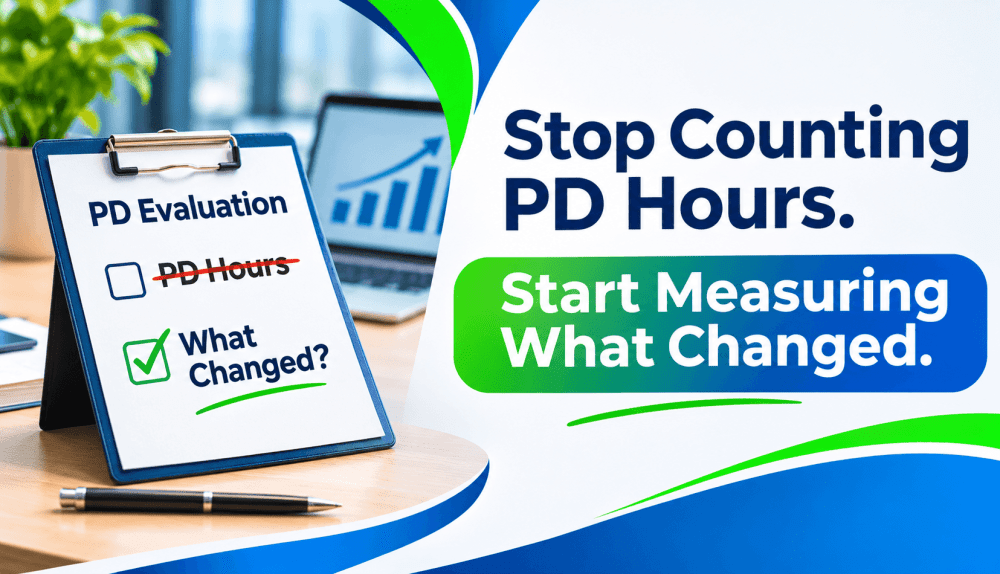
Stop Counting PD Hours. Start Measuring What Changed.

Professional development is one of those areas where it can be very easy for RTOs to focus on activity rather than impact.

We record the webinars trainers attended, the conferences they went to and the online courses they completed. We keep certificates, update PD logs and record hours. At the end of the year, we can produce plenty of evidence showing that professional development activity occurred.

But none of that necessarily tells us whether it made anyone better at their job.

Under the 2025 Standards for RTOs, workforce capability needs to be actively supported and developed. That means RTOs need to think beyond whether professional development has been completed and consider whether it is actually improving training and assessment practice.

What was the PD supposed to achieve?

One of the challenges with evaluating professional development is that RTOs don’t always establish what they expect it to achieve in the first place.

Perhaps validation has identified inconsistencies in assessment judgements. Maybe observations have shown that trainers need additional strategies for engaging a particular learner cohort. Learner feedback might have highlighted an area of delivery that needs attention.

Once we know what we’re trying to improve, we can select professional development that responds to that need and, importantly, determine afterwards whether it actually worked.

If we don’t know what we wanted the PD to achieve, it’s very difficult to measure its impact.

Completion isn't the same as impact

A certificate tells us that someone completed an activity. A PD log tells us what they did and when they did it. Neither necessarily tells us what they learnt, what they applied or whether their capability improved.

Imagine an RTO identifies that a trainer needs support with providing effective feedback. The trainer attends a two-hour workshop and adds the certificate to their PD record.

Has the capability need been addressed?

We don’t know.

The trainer might have completely changed their practice. They might have found the workshop too generic to be useful. They might have learnt some valuable strategies but need further support to apply them.

The certificate looks exactly the same in every scenario.

Measuring impact doesn't mean creating another form

The solution isn’t necessarily another piece of paperwork.

Evaluating impact should be connected to what the PD was intended to improve. If it was undertaken to strengthen training practice, an observation might provide useful evidence. If it related to assessment, validation might tell us whether practice has changed. Learner feedback, performance conversations, reflective discussions and assessment outcomes might also provide useful information.

What matters is the connection between the capability need, the professional development undertaken and the evidence that tells us whether it made a difference.

Sometimes that evidence will tell us the PD didn’t work. That’s useful too. It might indicate that different PD is needed, that the trainer needs further support, or that professional development wasn’t actually the right solution to the problem.

Professional development is a business investment

PD isn’t free, even when the activity itself is.

A free two-hour webinar completed by 30 trainers still represents 60 hours of staff time.

Add paid courses, conferences, subscriptions, consultants and other activities, and professional development can represent a significant investment for an RTO.

It makes sense to know whether that investment is producing results.

Over time, measuring impact can help an RTO identify which approaches genuinely improve workforce capability and which don’t. That information can then inform future decisions about where to spend both money and staff time.

Instead of asking, “How much PD have our trainers completed?”, we can ask, “Which of our professional development activities are actually improving capability?”

That’s a much more useful question.

Closing the loop

Good professional development should have a purpose.

We identify a capability need, determine how we’re going to address it, provide the development or support, and then come back to determine whether anything changed.

If it did, we have evidence that our approach was effective. If it didn’t, we’ve learnt something that should inform what we do next.

RTOs don’t need impressive PD logs filled with hours of webinars, conferences and courses. They need trainers and assessors who continue to develop the capability required to provide quality training and assessment.

So perhaps the most useful question to ask after professional development activity isn’t “Have we recorded this in the PD log?”

It’s “What changed because we did it?”

Leave a comment

Related posts

Product was successfully added to your cart!
Enquire Now
×

    Enquire Now