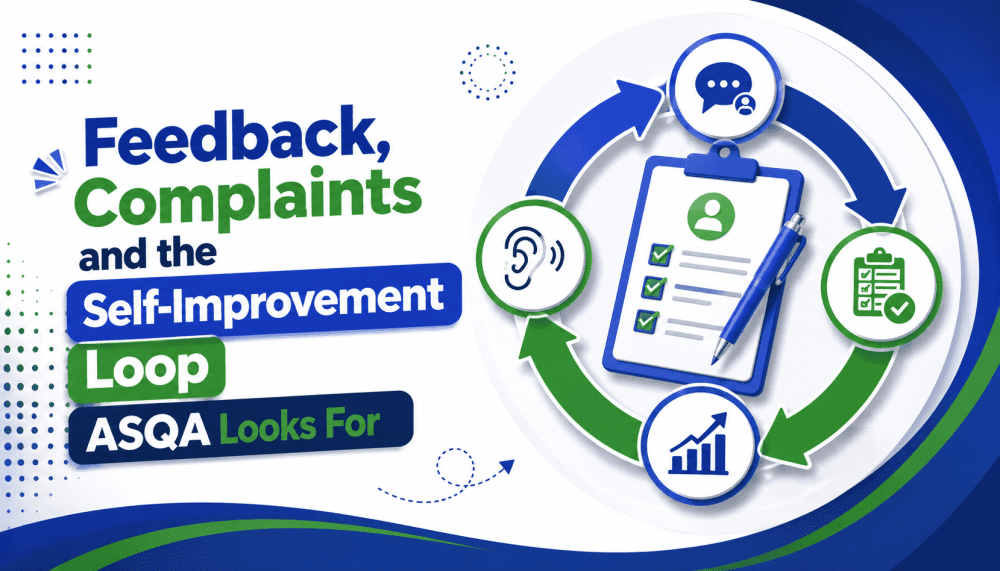
Feedback, Complaints and the Self-Improvement Loop ASQA Looks For
- July 3, 2026
- 260
Feedback, Complaints and the Self-Improvement Loop ASQA Looks For
◆ Who owns this: Student Services, Compliance & the CEO
Complaints are usually treated as problems to be closed. Under the 2025 Standards they are also evidence — of whether your system listens and improves. An RTO that resolves complaints but never learns from them is missing half the value and half the compliance benefit.
What the framework expects
Two things sit together here. First, complaints and appeals must be handled fairly, accessibly and transparently — students need a real, usable path to raise concerns. Second, feedback and complaints should inform continuous improvement, connecting Quality Area 2 to the self-assurance engine in Quality Area 4.
Where RTOs get exposed
- Process exists, access is poor. A complaints policy students cannot find or feel safe using.
- Closed but not learned from. Complaints resolved individually, with no pattern analysis.
- Feedback collected, never used. Surveys that go nowhere.
- No loop to improvement. No line from what students say to what the RTO changes.
The reframe. A complaint is not just a fire to put out — it is free data about where your systems are weak. RTOs that treat it that way generate continuous-improvement evidence as a by-product of good service.
What good evidence looks like vs what fails
✓ Holds up
× Gets flagged
How to close the gap
- Make the path real. Ensure students can easily and safely raise complaints and appeals.
- Look for patterns. Analyse complaints and feedback in aggregate, not just one by one.
- Act and record. Turn recurring themes into documented improvements.
- Wire it to self-assurance. Feed the loop into Quality Area 4 so improvement is systematic.
Does feedback actually change anything?
The free Risk Scorecard scores VET Student Support exposure — including whether your feedback loop is visible and working.
Frequently asked questions
1. What does the 2025 framework require for complaints handling?
Complaints and appeals must be handled fairly, accessibly and transparently, giving students a genuine path to raise concerns. The framework also expects feedback and complaints to inform continuous improvement.
2. How do complaints connect to self-assurance?
Complaints and feedback are data about where systems are weak. Analysing them for patterns and turning them into documented improvements links Quality Area 2 to the monitoring and improvement loop in Quality Area 4.
3. Is it enough to resolve complaints individually?
Resolving each complaint fairly is necessary but not sufficient. The stronger expectation is that you analyse complaints and feedback in aggregate and use them to improve, evidencing a system that learns rather than just reacts.
4. What evidence shows our feedback loop works?
A clear trail from student feedback or complaints, through pattern analysis, to a specific change you made — and ideally verification that the change helped. That trail is strong continuous-improvement evidence.
Sources: Outcome Standards Instrument 2025 (F2025L00354), Quality Area 2 (Standard 2.5 and complaints/appeals); ASQA Practice Guides (Student Support). Verified June 2026.
Related posts
Understanding Qualification Packs: A Guide for RTOs to Enhance Training and Assessment Standards
If you work in Australia’s VET sector, you’ve likely heard the term Qualification Packs —
RTO Scope of Registration: How to Add Qualifications and Units in Australia
Introduction For an Australian RTO, adding a qualification, accredited course, or standalone unit to
How to Complete Your Annual Declaration on Compliance
Introduction If you’re an RTO in Australia, the Annual Declaration on Compliance isn’t optional
Validation Isn’t Just About Improving Assessment. It’s About Improving Assessors.
For years, we’ve talked about validation as though its primary purpose is to improve assessment
Vocational Currency Is More Than Industry Experience
When vocational currency is discussed in the VET sector, the conversation tends to focus heavily on industry
Reflection is Not a Luxury: Why It Should Sit at the Centre of Professional Development
Professional development in the VET sector is often framed as something that happens outside of everyday
Leave a comment