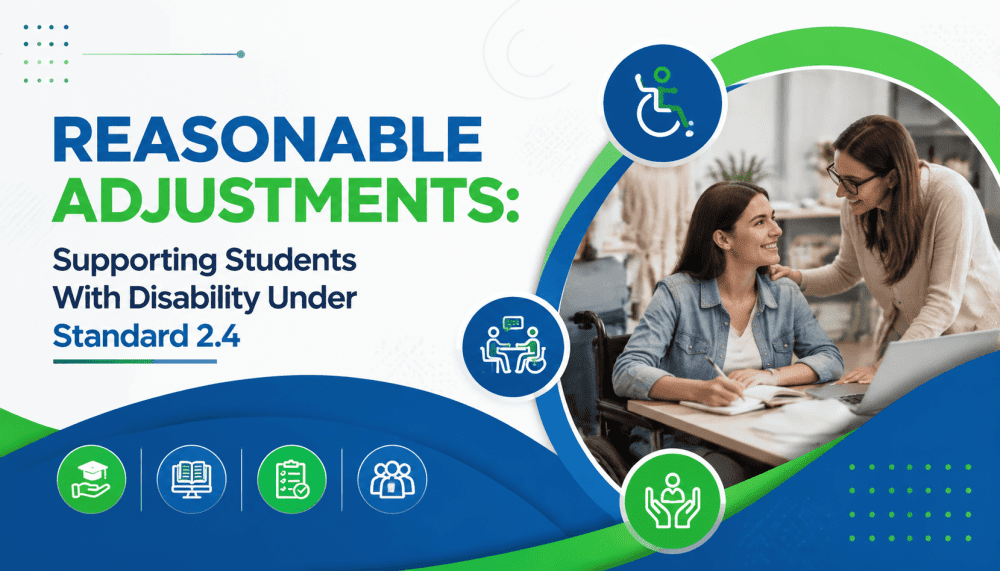
Reasonable Adjustments: Supporting Students With Disability Under Standard 2.4
- July 6, 2026
- 226
◆ Who owns this: Student Services, Trainers & the Compliance Manager
The short version: Standard 2.4 requires RTOs to make reasonable adjustments so students with disability can access and participate in training and assessment on an equal basis. The adjustment must support equal participation without compromising the integrity of the competency being assessed — and RTOs get exposed when adjustments are inconsistent, undocumented, or refused outright.
What Standard 2.4 requires
Reasonable adjustments must be made to support VET students with disability to access and participate in training and assessment on an equal basis. A reasonable adjustment is a measure that allows a student to participate without changing the essential requirements of the competency — for example, adjusting the format, timing, or environment of assessment, or providing assistive technology.
Where RTOs get exposed
- Adjustments refused or discouragedTreating an adjustment request as a problem rather than an obligation.
- Inconsistency. Adjustments that depend on which trainer a student happens to get.
- Compromising the competency. The opposite failure — adjusting so far that the student is no longer assessed against the actual requirements.
- No documentation. Adjustments made informally with no record of what was provided or why.
- No link to pre-enrolment. Needs not identified early, so adjustments are scrambled together late.
What good practice looks like vs what fails
✓ Holds up
× Gets flagged
How to close the gap
- Standardise the process. A consistent path for requesting, assessing and providing reasonable adjustments.
- Protect competency integrity Adjust access and method, never the essential requirements.
- Identify needs early. Use pre-enrolment to surface adjustment needs before training starts.
- Document everything.Record the adjustment, the rationale, and the outcome.
Are your adjustments consistent and documented?
TThe free Risk Scorecard scores VET Student Support exposure — including reasonable adjustments and equal participation.
Frequently asked questions
1. What does Standard 2.4 require for reasonable adjustments?
It requires RTOs to make reasonable adjustments so students with disability can access and participate in training and assessment on an equal basis. The adjustment should enable equal participation without changing the essential requirements of the competency.
2. Can a reasonable adjustment change what is assessed?
No. A reasonable adjustment changes how a student demonstrates competency — for example the format, timing, environment, or use of assistive technology — not whether they must meet the essential requirements. Adjusting so far that the competency itself is compromised is a failure
3. Do we have to grant every adjustment a student requests?
Adjustments must be reasonable and must preserve the integrity of the competency. The obligation is to genuinely support equal participation; where a specific request would compromise the essential requirements, the RTO works to find an alternative adjustment that does not.
4. How should reasonable adjustments be documented?
Record what adjustment was provided, the rationale, and the outcome. Identifying needs at pre-enrolment and documenting the response evidences both the support provided and that competency integrity was maintained.
Related posts
Understanding Qualification Packs: A Guide for RTOs to Enhance Training and Assessment Standards
If you work in Australia’s VET sector, you’ve likely heard the term Qualification Packs —
RTO Scope of Registration: How to Add Qualifications and Units in Australia
Introduction For an Australian RTO, adding a qualification, accredited course, or standalone unit to
How to Complete Your Annual Declaration on Compliance
Introduction If you’re an RTO in Australia, the Annual Declaration on Compliance isn’t optional
Validation Isn’t Just About Improving Assessment. It’s About Improving Assessors.
For years, we’ve talked about validation as though its primary purpose is to improve assessment
Vocational Currency Is More Than Industry Experience
When vocational currency is discussed in the VET sector, the conversation tends to focus heavily on industry
Reflection is Not a Luxury: Why It Should Sit at the Centre of Professional Development
Professional development in the VET sector is often framed as something that happens outside of everyday
Leave a comment