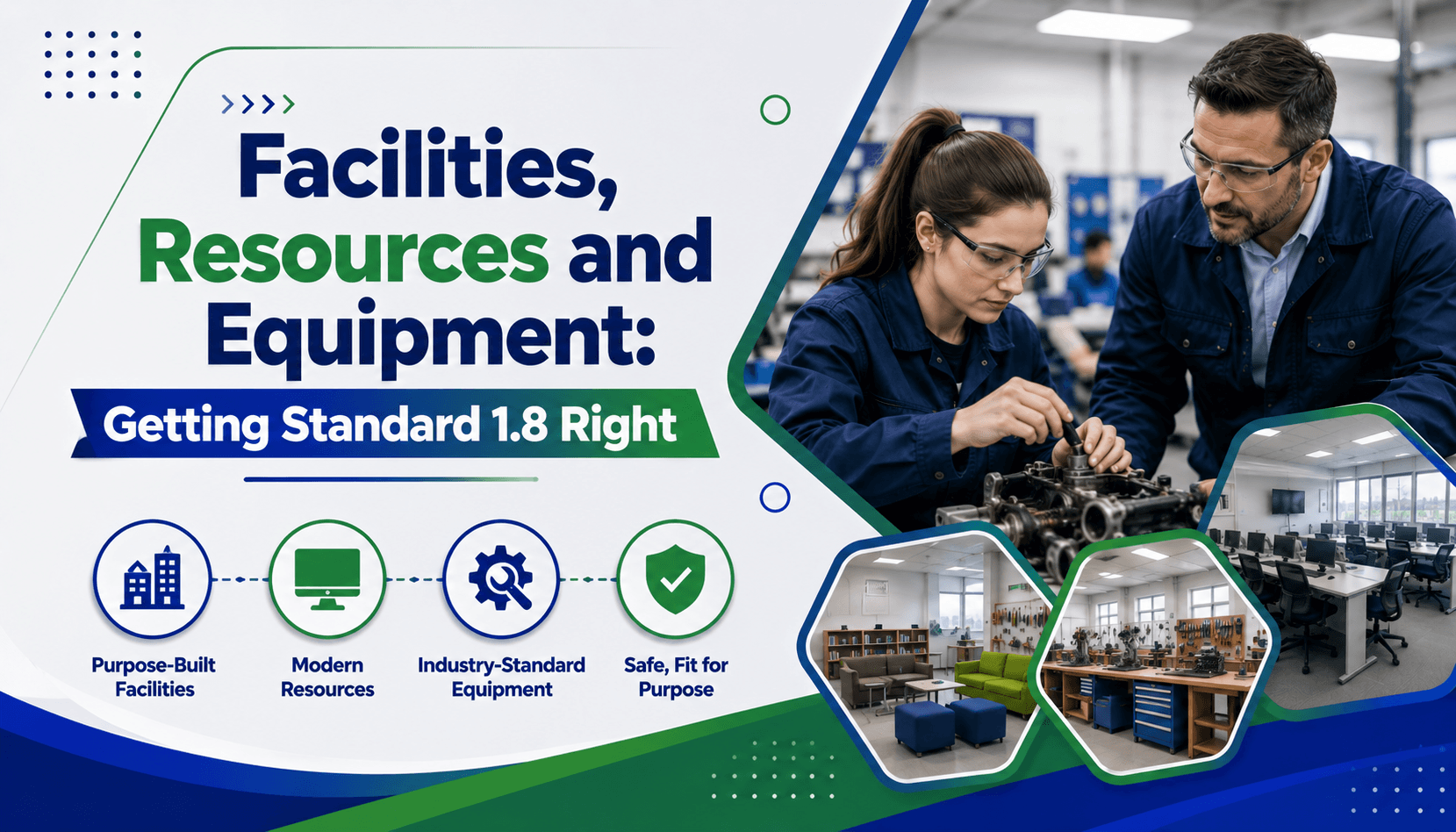
Facilities, Resources and Equipment: Getting Standard 1.8 Right
-
July 2, 2026
-
121
◆ Who owns this: Trainers, Assessors & the Compliance Manager
The short version: Standard 1.8 requires that facilities, resources and equipment for each training product are fit-for-purpose, safe, accessible and sufficient. It is a deceptively simple standard that catches RTOs delivering practical qualifications without the genuine physical capacity to do so — and it links directly to risk management and assessment validity.
Standard 1.8 is short, but it carries weight — especially for trade and practical qualifications. You cannot deliver hands-on competencies without the facilities and equipment to practise and be assessed in. An RTO that is light here is exposed across delivery, assessment validity and student safety at once.
What Standard 1.8 requires
For each training product, facilities, resources and equipment must be: fit-for-purpose (genuinely suitable for the competencies), safe (meeting work health and safety expectations), accessible (usable by all students, including those with disability), and sufficient (enough capacity for the cohort, not a single shared item for thirty students).
Where RTOs get exposed
- Nominal facilities. Equipment that technically exists but cannot realistically support delivery of the units on scope.
- Insufficient quantity. Enough for a demonstration but not for a cohort to develop and be assessed on real skills.
- Safety gaps. Practical environments that do not meet WHS expectations — a finding and a genuine risk.
- Accessibility overlooked. Facilities that exclude students with disability, intersecting with reasonable-adjustment obligations.
- Out-of-date resources. Learning resources or equipment that no longer reflect current industry practice or the training product.
The chain reaction. Weak facilities do not fail Standard 1.8 alone. They undermine training quality (1.1), assessment validity (1.3–1.4), risk management (4.3) and reasonable adjustments (2.4) simultaneously. One physical gap, several failing standards.
What good practice looks like vs what fails
✓ Holds up
× Gets flagged
How to close the gap
- Map facilities to every product on scope. Confirm each qualification’s units can genuinely be delivered and assessed with what you have.
- Check sufficiency, not just existence. Ensure quantity matches cohort size.
- Audit safety and accessibility. Meet WHS expectations and make facilities usable by all students.
- Refresh resources. Keep equipment and materials current to the product and industry.
Do your facilities match your scope?
The free Risk Scorecard scores Training & Assessment exposure — including whether facilities and resources hold up.
Frequently asked questions
What does Standard 1.8 require?
It requires that facilities, resources and equipment for each training product are fit-for-purpose, safe, accessible and sufficient. This applies to every product on scope, and is especially significant for practical and trade qualifications.
What does “sufficient” mean for equipment?
RPL must be properly evidenced against the training product, so some evidence is appropriate. However, the process must also be genuinely accessible and supportive — an evidence burden so heavy that students cannot realistically complete RPL undermines the intent of Standard 1.6.
Does Standard 1.8 cover online and blended delivery?
Yes. Resources and the learning environment must be fit-for-purpose for the chosen delivery mode. For online or blended delivery, this includes appropriate digital resources and platforms suited to the competencies being developed.
How does Standard 1.8 connect to other standards?
Facilities underpin training quality (1.1) and assessment validity (1.3–1.4), and intersect with risk management (4.3), reasonable adjustments (2.4) and WHS. A single facilities gap can create findings across several standards at once.
Related posts
Validation Isn’t Just About Improving Assessment. It’s About Improving Assessors.
For years, we’ve talked about validation as though its primary purpose is to improve assessment
Vocational Currency Is More Than Industry Experience
When vocational currency is discussed in the VET sector, the conversation tends to focus heavily on industry
Reflection is Not a Luxury: Why It Should Sit at the Centre of Professional Development
Professional development in the VET sector is often framed as something that happens outside of everyday
Reasonable Adjustments: Supporting Students With Disability Under Standard 2.4
Quality Area 2 · VET Student Support ◆ Who owns this: Student Services, Trainers & the Compliance
Appeals: The Process Students Need When a Decision Goes Against Them (Standard 2.8)
Quality Area 2 · VET Student Support ◆ Who owns this: Student Services, Compliance & the CEO The
Feedback, Complaints and the Self-Improvement Loop ASQA Looks For
Quality Area 2 · VET Student Support Feedback, Complaints and the Self-Improvement Loop ASQA Looks For

Leave a comment