
No products in the cart.
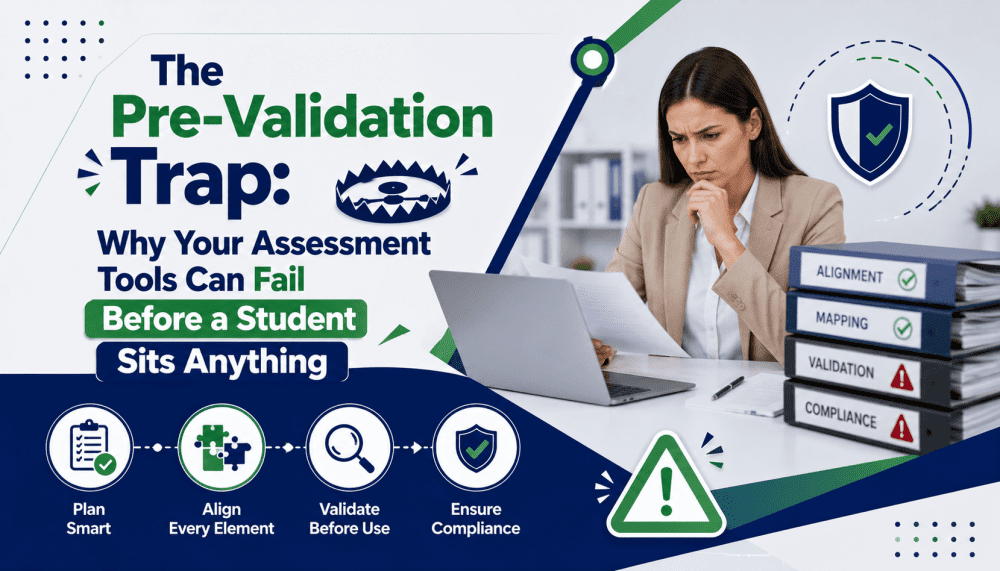


The short version: under the 2025 Standards, assessment validity is judged on whether your tools actually produce sound, consistent judgements in practice — and validation is expected to happen before tools are used, not as a post-mortem after a cohort has finished. RTOs that validate reactively, or only validate the easy products, carry one of the most common Quality Area 1 exposures.
Quality Area 1 is where most performance assessments live or die, and within it, assessment is where the sharpest findings cluster. The 2025 Standards did not invent validation — but they shifted the expectation from “do you have a validation schedule” to “can you show your judgements are valid, and that you caught problems before students were affected.”
The previous framework treated validation largely as a periodic, retrospective activity: sample completed assessments, review them, log improvements. That still matters. But the 2025 approach leans into pre-validation — checking that an assessment tool is fit for purpose, mapped to the training product, and capable of producing valid judgements before it is put in front of a student.
The logic is simple and, frankly, hard to argue with: if a tool is flawed, retrospective validation tells you that after you have already issued potentially invalid judgements. Pre-validation catches it before the damage is done. That is the trap in the name — an RTO can have a busy, well-documented validation calendar and still be exposed, because every validation event happens after delivery.
1. Validation that always runs after delivery
If your validation schedule only ever reviews completed student work, you have no evidence that tools were sound before use. An auditor reviewing a new qualification on your scope will ask a direct question: what did you do to assure this tool before the first student was assessed against it?
2. Validating only the easy or high-volume products
Validation is expected to be risk-based and to cover your scope over time. RTOs that validate their flagship qualification every year but leave low-volume or high-risk products untouched for years are exposed. Risk-based does not mean “whatever we got around to.” It means you can show why you prioritised what you did.
3. The TAS that does not match real delivery
Assessment validity is assessed in the context of how training is actually delivered. If your Training and Assessment Strategy describes one thing and your trainers do another, the mismatch undermines the validity argument regardless of how good the tool looks on paper.
The auditor’s first move. Experienced auditors do not start with your validation policy. They pick a product, pull the assessment tool, pull completed student evidence, and check whether the judgements are defensible — then they ask when and how the tool was validated. The policy is the last thing they read, not the first.
✓ Holds up
× Gets flagged
The free Risk Scorecard scores your Training & Assessment exposure in minutes — and shows where pre-validation and scheduling gaps sit.
For practical and trade qualifications, facilities and equipment must be genuinely adequate to deliver the relevant units. Nominal or inadequate facilities undermine both delivery quality and the validity of any assessment that follows.
Sources: Outcome Standards Instrument 2025 (F2025L00354), Quality Area 1; ASQA Practice Guides (Training and Assessment); asqa.gov.au/standards-for-RTOs. Verified June 2026.
For years, we’ve talked about validation as though its primary purpose is to improve assessment
When vocational currency is discussed in the VET sector, the conversation tends to focus heavily on industry
Professional development in the VET sector is often framed as something that happens outside of everyday
Quality Area 2 · VET Student Support ◆ Who owns this: Student Services, Trainers & the Compliance
Quality Area 2 · VET Student Support ◆ Who owns this: Student Services, Compliance & the CEO The
Quality Area 2 · VET Student Support Feedback, Complaints and the Self-Improvement Loop ASQA Looks For
Join Our Email List & Receive Special Offers

RTO Resource Australia provides resources and support designed to assist RTOs with training, assessment and compliance processes. Resources must be reviewed, contextualised and implemented by each RTO according to its scope, delivery model, learner cohort, assessment conditions and regulatory obligations. No resource provider can guarantee audit outcomes, regulatory approval or compliance status.
@ 2026 RTO Resource Australia. All Rights Reserved.

Leave a comment