preload-image

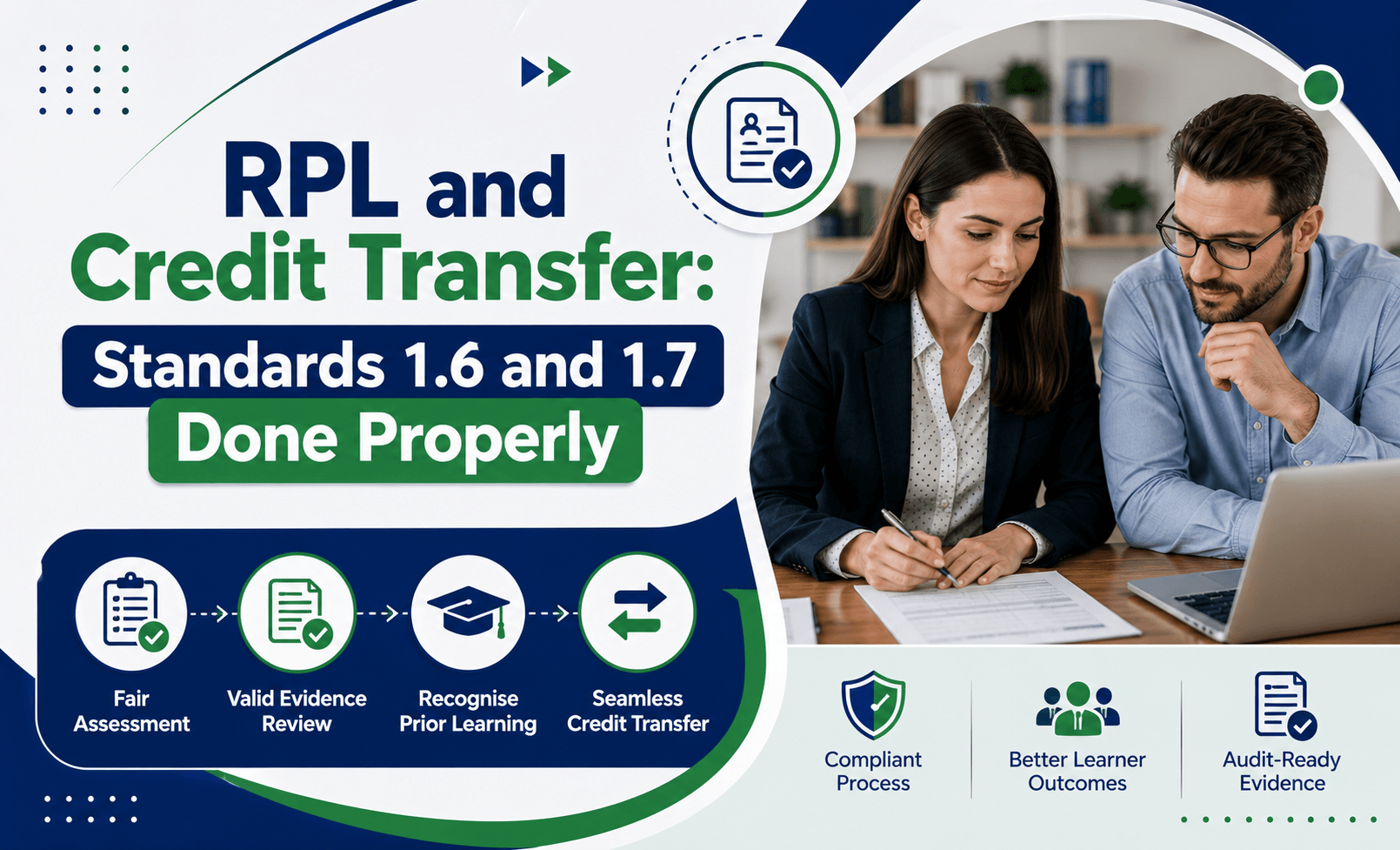
RPL and Credit Transfer: Standards 1.6 and 1.7 Done Properly

Quality Area 1 · Training & Assessment
◆ Who owns this: Trainers, Assessors & the Compliance Manager

The short version: Standards 1.6 and 1.7 require you to actively support students to seek recognition of prior learning (RPL) and to have previously completed equivalent training recognised via credit transfer. The 2025 framing is about genuine access and support — not a token RPL policy nobody uses. RTOs get exposed when RPL is offered on paper but made impractical in reality.

RPL and credit transfer are easy to treat as box-ticking. The 2025 Standards frame them as student-centred obligations: students with existing skills or prior study should be supported to have them recognised, so they are not forced to repeat learning they have already mastered.

What Standards 1.6 and 1.7 require

Standard 1.6 — Recognition of Prior Learning
VET students with prior skills, knowledge and competencies must be supported to seek RPL to progress through the relevant training product. The key word is supported — the process should be genuinely accessible, not buried or discouraged.

Standard 1.7 — Credit Transfer
VET students who have previously completed an equivalent training product must be supported to have that training recognised. Where a student holds a current, equivalent unit or qualification, credit transfer should be straightforward and offered.

Where RTOs get exposed

  • RPL that exists but is impractical. A policy on the website, but an evidence burden so heavy that nobody completes it.
  • RPL assessed without proper rigour. The opposite failure — granting RPL without sound evidence against the training product.
  • Credit transfer not offered. Students re-enrolling in units they have already completed elsewhere because credit transfer was never raised.
  • No link to pre-enrolment. The 2025 pre-enrolment assessment should surface prior skills and study — if it does not flow into RPL/credit transfer, the system is disconnected.

The balance that matters. RPL has two failure modes — too hard (nobody can access it) and too soft (granted without evidence). Both are findings. Good RPL is accessible and rigorous: easy to start, properly evidenced against the training product.

What good practice looks like vs what fails

✓ Holds up

An accessible, genuinely usable RPL process students complete
RPL judgements properly evidenced against the training product
Credit transfer offered and processed for equivalent prior study
Pre-enrolment assessment feeding RPL and credit transfer

× Gets flagged

RPL policy that exists but is impractical to use
RPL granted without sound evidence
Credit transfer never offered, students repeating completed units
No connection between pre-enrolment and recognition

How to close the gap

  1. Make RPL genuinely accessible. Streamline the process and actively offer it, while keeping evidence requirements sound.
  2. Keep RPL rigorous. Map RPL evidence to the training product so judgements are defensible.
  3. Offer credit transfer by default. Check for equivalent prior study at enrolment and process it.
  4. Connect it to pre-enrolment. Use pre-enrolment assessment to surface prior skills and study, then route into RPL or credit transfer.

Is your RPL accessible AND rigorous?

The free Risk Scorecard scores your Training & Assessment exposure — including where recognition processes fall short.

Frequently asked questions

Standard 1.6 requires that students with prior skills, knowledge and competencies are supported to seek recognition of prior learning to progress through the training product. Standard 1.7 requires that students who have previously completed an equivalent training product are supported to have it recognised through credit transfer.

RPL must be properly evidenced against the training product, so some evidence is appropriate. However, the process must also be genuinely accessible and supportive — an evidence burden so heavy that students cannot realistically complete RPL undermines the intent of Standard 1.6.

For practical and trade qualifications, facilities and equipment must be genuinely adequate to deliver the relevant units. Nominal or inadequate facilities undermine both delivery quality and the validity of any assessment that follows.

The 2025 pre-enrolment assessment is designed to surface a student’s existing skills and prior study. That information should flow directly into RPL and credit transfer decisions, so students are not enrolled into learning they have already completed.

Sources: Outcome Standards Instrument 2025 (F2025L00354), Quality Area 1 (Standards 1.6, 1.7); ASQA Practice Guides. Verified June 2026.

Leave a comment

Related posts

Product was successfully added to your cart!
Enquire Now
×

    Enquire Now