preload-image

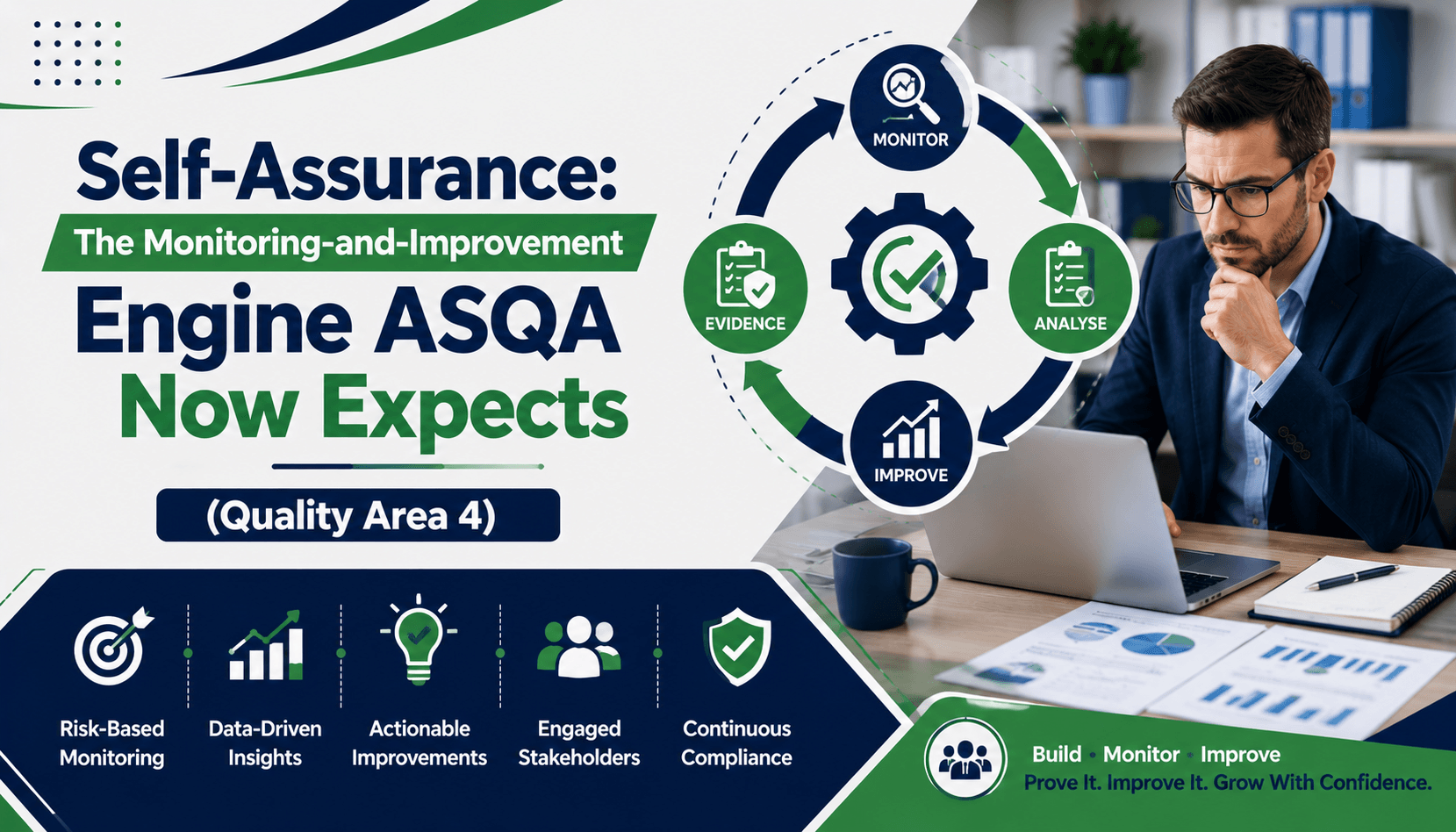
Self-Assurance: The Monitoring-and-Improvement Engine ASQA Now Expects (Quality Area 4)

Quality Area 4 · Monitoring & Improvement

◆ Who owns this: CEO, Compliance Manager & the whole organisation

The short version: self-assurance is the engine the 2025 Standards are built around. Quality Area 4 expects you to systematically monitor your own performance, evaluate it honestly, and improve — and crucially, to evidence that loop running. It is no longer enough to have a policy; you must show you watch whether it works and act when it does not.

If you understand self-assurance, you understand the 2025 Standards. Almost every other expectation — pre-validation, support effectiveness, governance oversight, currency — is really an instance of the same idea: don’t just do the thing, monitor whether it’s working and improve it.

What self-assurance actually means

Self-assurance is an RTO’s own ongoing process of checking that its systems are operating effectively and producing quality outcomes — and fixing them when they are not. The 2025 framing makes this the central regulatory expectation. ASQA’s 2026 audits look for evidence that you assure yourself, continuously, rather than waiting for the regulator to find problems.

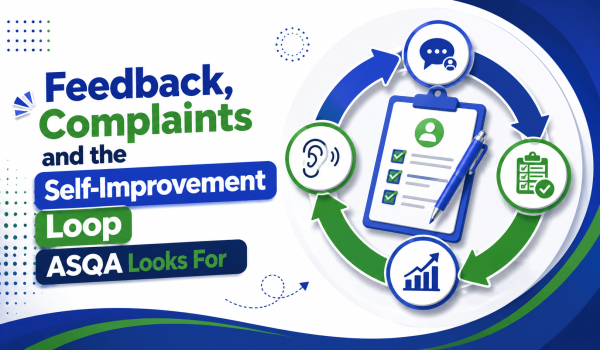
The loop ASQA wants to see

  1. Monitor. Collect real data on how your systems perform — completion, assessment validity, support uptake, complaints, trainer currency, and so on.
  2. Evaluate. Honestly assess what the data says. This step is where many RTOs stall — they collect but do not interpret.
  3. Act. Make changes in response to what you found.
  4. Verify. Check that the change worked. An unclosed loop is not self-assurance.
Where most RTOs break the loop. They monitor (data exists) and they may even evaluate (someone reads it), but the loop stops there — no action, or action with no verification. ASQA can see a broken loop instantly: lots of reports, no evidence anything changed because of them.

What good evidence looks like vs what fails

✓ Holds up

Performance data collected across all four Quality Areas
Documented evaluation — someone made sense of the data
Actions taken in response, with owners and dates
Verification that the action actually fixed the issue
Governance engagement with the whole loop

× Gets flagged

Data collected but never interpreted
Reports received with no resulting decisions
Actions with no follow-up to confirm they worked
Self-assurance treated as an annual event, not continuous
Improvement that lives in people’s heads, not on record

How to build it

  1. Pick your signals. Choose a manageable set of indicators across the four Quality Areas that genuinely tell you whether things are working.
  2. Schedule the evaluation. Put a recurring slot in the calendar where someone interprets the data and proposes actions.
  3. Track actions to closure. Use a simple register: issue, action, owner, date, verified outcome.
  4. Wire it into governance. The board should see the loop, not just the raw reports — that is how Quality Area 4 ties together.

Is your self-assurance loop actually closing?

The free Risk Scorecard scores your Governance and self-assurance exposure — and shows where the loop breaks.

Frequently asked questions

Self-assurance is an RTO’s own ongoing process of monitoring whether its systems are operating effectively, evaluating the results, acting to improve, and verifying that the action worked. The 2025 Standards make this continuous self-monitoring the central regulatory expectation.

An audit is a point-in-time external check. Self-assurance is the RTO continuously assuring itself between audits. The 2025 approach expects you to find and fix issues yourself rather than waiting for the regulator to surface them, and to evidence that you do so.

Evidence of the full loop: performance data across the Quality Areas, documented evaluation of that data, actions taken with owners and dates, and verification that the actions resolved the issue. A broken loop — data with no action, or action with no follow-up — is a common finding.

Self-assurance is continuous, not annual. While some evaluations may be periodic, the overall expectation is ongoing monitoring and improvement, with governance engaged throughout rather than once a year.

Leave a comment

Related posts

Product was successfully added to your cart!
Enquire Now
×

    Enquire Now