
No products in the cart.
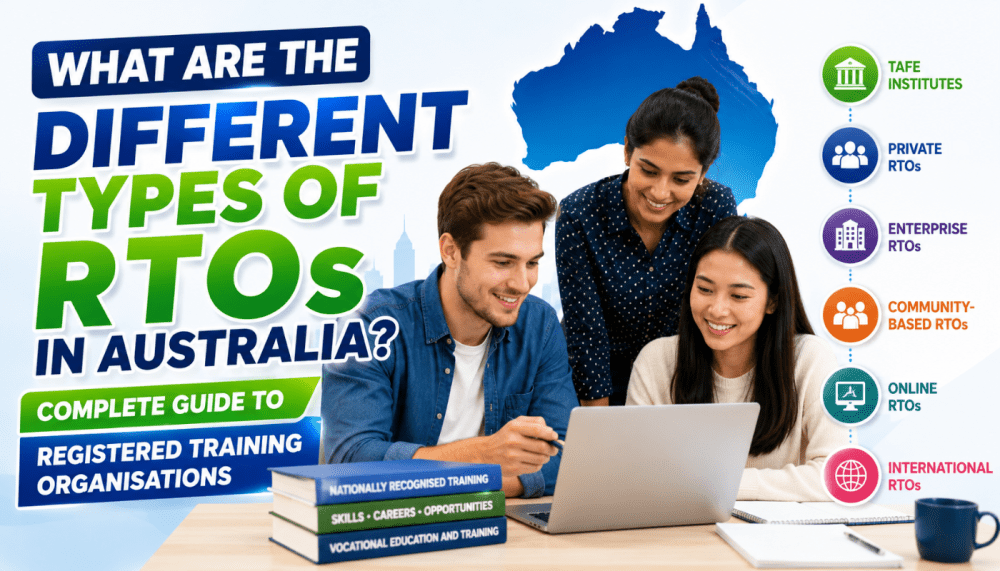


Australia’s Vocational Education and Training (VET) sector plays a major role in preparing students for real-world careers. At the centre of this system are Registered Training Organisations (RTOs), which deliver nationally recognised qualifications and industry-relevant skills across various sectors.
If you are planning to study a vocational course, become an international student, upskill for employment, or even establish your own training organisation, understanding the different types of RTOs in Australia is essential.
With hundreds of training providers operating across the country, choosing the right RTO can feel overwhelming. Each type of RTO serves different purposes, industries, and student groups. Some focus on large-scale public education, while others specialise in niche industry training or employee development.
In this guide, you will learn:

A Registered Training Organisation (RTO) is an education provider authorised to deliver nationally recognised training and qualifications in Australia.
RTOs operate under the Australian Qualifications Framework (AQF) and are regulated by the Australian Skills Quality Authority (ASQA) or equivalent state regulators.
These organisations provide Vocational Education and Training (VET) programs designed to help students gain practical skills and qualifications for employment, career advancement, or further study.

RTOs are responsible for:
Only an approved RTO can issue nationally recognised qualifications such as:
Because these qualifications meet Australian national standards, they are highly respected by employers both in Australia and internationally.
RTOs form the backbone of Australia’s vocational education system by helping students develop practical, job-ready skills aligned with industry needs.

They contribute to
RTOs also support industries such as:
Whether you are a school leaver, working professional, or international student, RTOs provide flexible pathways into employment and higher education.
Technical and Further Education (TAFE) institutes are government-owned RTOs that deliver vocational education and training across Australia.
TAFEs are among the most established and trusted training providers in the country and offer courses in a wide range of industries.
Key Characteristics of TAFE Institutes
Courses Offered by TAFEs
TAFEs commonly provide:
Benefits of TAFE RTOs
TAFEs are ideal for students seeking structured learning environments and strong employment pathways.
Private RTOs are independently owned training organisations that deliver vocational education across various industries.
Some private RTOs offer broad course selections, while others specialise in niche sectors such as cybersecurity, aged care, hospitality, or construction.

Key Characteristics of Private RTOs
Private RTOs are popular among working professionals and students seeking flexible education pathways.
Enterprise RTOs are training organisations established by companies to deliver internal staff training and workforce development.
These RTOs help businesses ensure employees have the skills and qualifications required for operational success and compliance.
Key Characteristics of Enterprise RTOs
Benefits of Enterprise RTOs

Enterprise RTOs are commonly used in industries such as mining, aviation, manufacturing, healthcare, and logistics.
Community-based RTOs are usually non-profit organisations focused on improving education access within local communities.
These RTOs often support disadvantaged or underrepresented groups by offering affordable and accessible vocational training.
Student Groups Often Supported
Benefits of Community-Based RTOs
These RTOs play a critical role in promoting education equality and workforce participation.
Industry association RTOs are created by professional organisations or industry bodies to provide specialised training for members and professionals.
These RTOs ensure training aligns closely with industry standards, regulations, and workforce requirements.
Benefits of Industry Body RTOs
These RTOs are ideal for professionals seeking specialised qualifications and career advancement.
CRICOS RTOs are training providers registered on the Commonwealth Register of Institutions and Courses for Overseas Students (CRICOS).
These organisations are authorised to deliver training to international students studying in Australia on student visas.
CRICOS providers must:
CRICOS RTOs are essential to Australia’s international education sector.
Selecting the right RTO can significantly impact your learning experience and career outcomes.
Verify the RTO’s registration on:
Ensure the qualification is nationally recognised under the AQF framework.
3. Compare Learning Options
Look for:
4. Assess Industry Connections
Strong employer partnerships can improve job placement opportunities.
5. Read Student Reviews
Research student experiences and graduate outcomes.
6. Check Support Services
Especially important for:
7. Compare Fees and Value
The cheapest option is not always the best. Consider quality, trainer experience, and student support.

An RTO is a Registered Training Organisation authorised to deliver nationally recognised
qualifications in Australia.
Yes. TAFE institutes are government-owned Registered Training Organisations.
An RTO delivers nationally recognised training, while a CRICOS RTO is additionally approved to enrol international students on student visas.
Yes, provided the RTO is officially registered and compliant with ASQA standards
You can verify an RTO’s registration status on the official National Register at training.gov.au.
Understanding the different types of RTOs in Australia is important for students, employers, and education providers alike.
Whether you choose a TAFE institute, private RTO, enterprise RTO, or CRICOS provider, selecting the right training organisation can help you achieve your education and career goals.
Before enrolling, always ensure the RTO is ASQA-compliant, nationally recognised, and aligned with your learning needs.
As Australia’s vocational education sector continues to grow, RTOs remain essential in delivering industry-relevant skills, workforce training, and career development opportunities across the country.

For years, we’ve talked about validation as though its primary purpose is to improve assessment
When vocational currency is discussed in the VET sector, the conversation tends to focus heavily on industry
Professional development in the VET sector is often framed as something that happens outside of everyday
Quality Area 2 · VET Student Support ◆ Who owns this: Student Services, Trainers & the Compliance
Quality Area 2 · VET Student Support ◆ Who owns this: Student Services, Compliance & the CEO The
Quality Area 2 · VET Student Support Feedback, Complaints and the Self-Improvement Loop ASQA Looks For
Join Our Email List & Receive Special Offers

RTO Resource Australia provides resources and support designed to assist RTOs with training, assessment and compliance processes. Resources must be reviewed, contextualised and implemented by each RTO according to its scope, delivery model, learner cohort, assessment conditions and regulatory obligations. No resource provider can guarantee audit outcomes, regulatory approval or compliance status.
@ 2026 RTO Resource Australia. All Rights Reserved.

Leave a comment